
Every 40 minutes, an Indian loses their life to electrocution. According to data from the National Crime Records Bureau, <a>more than 12,500 people die every year due to electrical accidents across India</a> — a number that continues to climb. Behind many of these tragedies is a simple, overlooked truth: the right safety device was never installed. A Residual Current Circuit Breaker, or RCCB, can detect electrical leakage in milliseconds and cut the power before it reaches a human body. But not every RCCB on the market performs equally well. Choosing the best RCCB brand in India is no longer a luxury — in 2026, it is a matter of life and property.
This guide was written for homeowners upgrading their electrical panels, contractors specifying equipment for new construction, facility managers overseeing commercial buildings, and anyone who wants to make an educated choice about electrical safety. Whether you are protecting a single-bedroom apartment in Chennai or a multi-floor industrial unit in Pune, the information below will walk you through what an RCCB actually does, what technical specifications matter most, and which brands have earned their reputation in the Indian market.
Before diving into the brand comparison, it helps to understand why the selection of the best RCCB brand in India deserves this level of attention. India’s electrical grid carries unique challenges — voltage fluctuations, aging wiring in older constructions, high humidity during monsoon seasons, and inconsistent earthing in many localities. These conditions demand an RCCB that is not just certified on paper but genuinely robust in performance. A device that trips too slowly, or worse, one that fails to trip at all, offers a false sense of security that can prove deadly.
What Is an RCCB and Why Does It Matter in Indian Homes and Industries
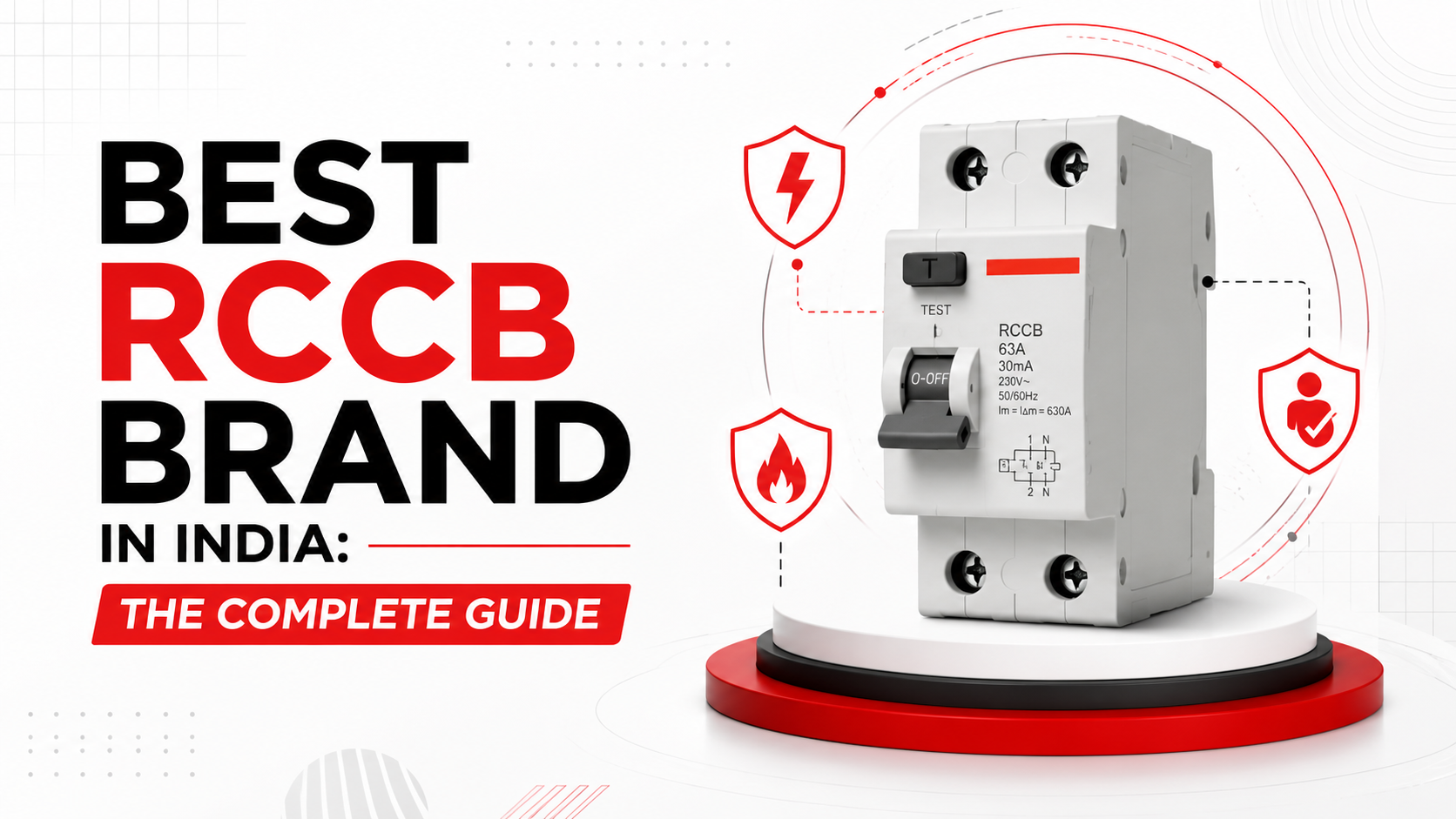
An RCCB, which stands for Residual Current Circuit Breaker, is a protective safety device installed in electrical distribution boards. Its fundamental job is to continuously monitor the current flowing through the live and neutral wires of a circuit. Under normal operating conditions, the current entering through the live wire should return exactly through the neutral wire. When a person accidentally touches a live conductor, a small but potentially fatal current leaks out of the circuit through the body to the ground. The RCCB detects this imbalance — often as small as 30 milliamperes — and disconnects the circuit within 30 milliseconds, a speed fast enough to prevent cardiac arrest.
What makes the RCCB different from a standard Miniature Circuit Breaker, or MCB, is the nature of the threat it addresses. An MCB protects against overloads and short circuits — high-current events that can damage wiring and start fires. An RCCB, on the other hand, protects human lives from low-level leakage currents that an MCB would never detect. The two devices are complementary, not interchangeable. In a well-designed electrical installation, both should be present, and increasingly, electricians are installing combined devices like RCBOs that offer both functions in a single unit.
The importance of this device has grown considerably in recent years. India’s Bureau of Indian Standards mandates RCCB installation in bathrooms, kitchens, garages, and outdoor circuits under IS 732 wiring regulations. Many state electricity boards and urban local bodies now require RCCB protection as part of building approval documentation. Despite this, a large portion of Indian homes — particularly in Tier 2 and Tier 3 cities — still operate without a functioning RCCB. Identifying the best RCCB brand in India, therefore, carries genuine public health significance.
Key Technical Specifications to Understand Before Buying
Understanding the technical language around RCCBs will help you make an informed purchase decision rather than relying entirely on brand name alone. The first parameter to look for is the rated current, typically expressed in amperes. Common values are 25A, 40A, and 63A for residential use, and 80A or 100A for commercial and industrial applications. Your RCCB’s rated current must be matched to the maximum load the protected circuit will carry.
The second critical specification is the sensitivity or residual operating current, denoted as IΔn. A 30mA sensitivity rating is the global standard for personal protection in homes and offices because the human heart can go into fibrillation at currents as low as 30 to 50 milliamperes. A 100mA RCCB is generally used for fire protection rather than personal safety, and 300mA devices are used as selective upstream protection in industrial panel hierarchies. For most Indian homes, a 30mA RCCB at the distribution board level is the minimum recommended installation.
The third parameter is the type classification, which many buyers overlook entirely. Type AC RCCBs detect only sinusoidal alternating current leakage and are sufficient for circuits powering conventional appliances. Type A RCCBs additionally detect pulsating direct current leakage, making them necessary for circuits serving washing machines, variable speed drives, and modern inverter-based appliances that are now common in urban Indian households. Type B RCCBs handle all leakage types including smooth direct current and are required in industrial environments with drives and renewable energy systems. Choosing the wrong type can leave critical appliances unprotected even with an RCCB installed.
The number of poles is the fourth consideration. A 2-pole RCCB protects single-phase circuits — the standard setup in most Indian homes — while a 4-pole RCCB is designed for three-phase circuits found in commercial and industrial installations. All reputable brands offer both configurations, but pricing can vary significantly between them.
The Best RCCB Brand in India: A Detailed Comparison of the Top 7 Brands
With the technical foundation in place, evaluating the leading brands becomes a much clearer exercise. The Indian RCCB market in 2026 is dominated by a combination of Indian manufacturers and global multinationals with deep local presence. Here is how the leading players compare.
Havells India stands as arguably the most recognized name in the Indian residential electrical market. Founded in 1958, Havells has grown into a pan-India electrical conglomerate with its own manufacturing facilities, a robust dealer network across every district, and strong after-sales service. Its RCCB lineup spans the Bi Mono, DX series, and the premium Reo range, offering Type AC and Type A variants in 2-pole and 4-pole configurations from 25A to 100A. Havells RCCBs are designed and manufactured to meet international safety standards and are subject to rigorous testing protocols. Starting prices for Havells RCCBs begin around ₹1,481 for a 40A double-pole unit, making them accessible for budget-conscious buyers without compromising on quality. For an Indian homeowner who values brand familiarity, wide availability at local hardware shops, and reliable warranty support, Havells consistently ranks at or near the top.
Schneider Electric is a French multinational with one of the widest RCCB portfolios sold in India under the Acti9, Easy9, and Resi9 product lines. Schneider’s Acti9 iID series is particularly popular among electrical contractors and consultants because of its smart home compatibility, dual terminals that allow both top and bottom cable entry, and its clean traceability for IEC/EN 61008-1 compliance. A Schneider Electric Acti9 25A Double Pole RCCB is priced around ₹2,052, reflecting the slight premium that comes with global engineering credentials. Schneider is frequently the preferred brand in premium residential projects, commercial office spaces, and hospitality installations where documentation and long-term reliability are priorities. The Resi9 range specifically caters to budget-conscious residential users without sacrificing the core quality standards the brand is known for.
Siemens brings its Betagard 5SV and 5SM RCCB series to the Indian market, and these products have carved out a loyal following among industrial electricians and panel builders. The 5SV series offers a patented SLR (spring-loaded release) feature for ease of mounting, a motorized mechanism for remote ON/OFF capability in premium variants, and a test push button that allows end users to verify functionality without tools. Siemens RCCBs carry IEC 61008-1 certification and are built with the kind of engineering precision one expects from a 175-year-old German company. They are particularly recommended for CNC machines, compressors, and other industrial equipment where precision and robustness justify the higher investment.
ABB is another Swiss-Swedish engineering giant with a strong presence in India’s industrial electrical market. ABB RCCBs, particularly the F200 series and SN200 series, combine advanced safety features with reliability across residential, commercial, and industrial environments. ABB’s manufacturing operations in India produce RCCBs that meet both international IEC standards and Indian IS standards, and the brand’s four-pole Type B variants are widely used in renewable energy installations, including solar rooftop systems and EV charging infrastructure. ABB’s strength lies in its industrial and commercial segment rather than the mass residential market, where Havells and Schneider tend to dominate.
Legrand is a French company that has made significant inroads into India’s premium residential and commercial segment. Legrand RCCBs, particularly the DX3 range, are recognized for their durability, innovative terminal design, and compatibility with Legrand’s broader modular wiring accessory ecosystem. Many interior designers and architects specify Legrand when working on premium apartments and bungalows because the brand’s modular plates, switches, and protective devices all form a coherent aesthetic and technical system. The DX3 RCCB is compact, easy to install in tight distribution boards, and offers excellent vibration resistance — a useful quality in buildings near high-traffic zones.
L&T Electrical and Automation, now operating under the Lauritz Knudsen brand following a strategic divestment, has been a trusted name in Indian electrical switchgear for decades. L&T RCCBs carry the credibility of one of India’s largest industrial conglomerates and are widely used in industrial panels, factory installations, and government infrastructure projects. Their products are available across India at competitive prices, with L&T RCCB starting prices from around ₹450 to ₹1,000 depending on the rating and configuration. For project engineers and electrical consultants working on government contracts or infrastructure projects where Indian brand pedigree matters in tendering, L&T remains a strong and trusted choice.
HPL Electric and Power, while less globally recognized than some of the names above, has established itself as a reliable Indian manufacturer of RCCBs that adhere to IS and IEC safety standards. HPL’s RCCBs are known for performance at competitive price points, making them a popular choice among electrical contractors working on budget residential projects and mass housing schemes. HPL’s wide distributor network across Tier 2 and Tier 3 cities means availability is rarely an issue, and the brand’s growing focus on quality certifications has earned it growing acceptance in commercial applications as well.
How to Choose the Right RCCB for Your Specific Application
Having reviewed the top brands, the next logical question is how to match the right brand and model to your specific situation. The answer depends on four variables: your application type, your budget, your location’s infrastructure conditions, and your after-sales service needs.
For a standard urban apartment with a single-phase supply and modern appliances including washing machines, air conditioners, and induction cooktops, the ideal choice is a Type A, 2-pole, 40A RCCB with 30mA sensitivity from either Havells, Schneider Electric, or Siemens. Any of these brands will offer IS-certified products with five-year warranties and readily available replacements at local electrical shops. If your distribution board already uses Schneider MCBs, adding a Schneider RCCB makes sense from a compatibility and aesthetics standpoint.
For a three-phase commercial office, retail outlet, or small manufacturing unit, moving up to a 4-pole RCCB from Schneider, ABB, or Siemens is the right approach. These brands offer selectivity coordination with upstream MCCBs and ACBs, ensuring that a fault on one circuit does not trip the entire facility. The Type A classification is sufficient for most commercial setups, but if your office uses dedicated workstations with UPS systems or if you are in the process of installing EV charging points, investing in Type B RCCBs from ABB gives you future-proof protection.
For heavy industrial environments — steel fabrication, chemical processing, food manufacturing — Type B RCCBs from ABB or Siemens are the professional recommendation. These environments expose electrical systems to smooth DC leakage from variable frequency drives, rectifiers, and switchmode power supplies that a Type AC or Type A RCCB would miss entirely. In addition to the RCCB type, industrial users should look at time-delayed variants (S-type RCCBs) that allow selective coordination, ensuring that only the affected circuit trips rather than the entire panel.
For those in rural areas or smaller towns where electrical infrastructure is less stable and voltage fluctuations are common, Havells and L&T offer the advantage of the strongest distributor networks in India, ensuring that replacement units are available within hours rather than days. Both brands also have wide service networks across non-metro geographies.
Common Mistakes Indian Buyers Make When Purchasing an RCCB
One of the most frequent errors is purchasing an RCCB based solely on price. A low-cost RCCB from an unknown brand might pass a visual inspection but fail to trip within the required time under actual fault conditions. In India, there have been documented cases of sub-standard circuit breakers that carry fake ISI marks and do not perform to specification. The Bureau of Indian Standards conducts periodic market surveillance, but counterfeit products still circulate. Sticking to established brands from authorized distributors or reputable e-commerce platforms with genuine warranty documentation is the safest approach.
The second mistake is choosing the wrong sensitivity rating. Installing a 300mA RCCB in a home bathroom does not protect human life — it only provides fire protection. Personal safety requires 30mA sensitivity on circuits in wet areas and at the main distribution board. Many homeowners unknowingly accept whatever the contractor installs without questioning the milliampere rating stamped on the device.
The third error is neglecting to test the RCCB after installation and at regular intervals thereafter. Every RCCB from every reputable brand includes a test button on its face. Pressing this button simulates a fault current and should cause the device to trip immediately. If it does not trip, the device is defective and must be replaced before the installation is commissioned. Electricians and homeowners alike should perform this test at least once every six months as a basic maintenance practice.
The fourth mistake, particularly prevalent in older buildings undergoing renovation, is installing an RCCB without verifying that the building has a functional earth connection. An RCCB detects leakage current relative to a return path — if the earth connection is absent, the device may not function correctly. Checking the earthing system is a prerequisite for any RCCB installation.
Price Range and Where to Buy RCCBs in India in 2026
The Indian RCCB market in 2026 offers a wide price band to suit different budgets and applications. For a standard 2-pole, 25A, 30mA Type AC RCCB, prices start from approximately ₹700 to ₹900 for domestic-tier Indian brands, ₹1,400 to ₹2,000 for mid-tier established brands like Havells and L&T, and ₹2,000 to ₹3,500 for premium international brands like Schneider Electric, Siemens, and ABB. Four-pole RCCBs and Type B units command significantly higher prices, with premium industrial models ranging from ₹5,000 to ₹15,000 depending on the current rating.
Authorized distributors and electrical hardware shops remain the most reliable purchasing channel for contractors and projects requiring bulk supply. For individual homeowners, platforms like Amazon.in, Flipkart, and specialized electrical B2B portals like Eleczo.com and Moglix offer genuine products with manufacturer warranties, GST-compliant billing, and delivery across more than 20,000 pincodes in India. It is advisable to cross-check the product’s ISI certification number on the BIS Care app before purchase when buying from unfamiliar sellers.
The Best RCCB Brand in India: Final Verdict for 2026
After reviewing technical specifications, brand heritage, pricing, after-sales networks, and application fit, the conclusion is clear — there is no single best RCCB brand in India for every situation. The right answer depends on what you are protecting and what your priorities are.
For the best overall residential RCCB in India, Havells leads the pack by combining quality, wide availability, competitive pricing, and strong brand support across urban and rural markets. For the best premium residential and commercial RCCB, Schneider Electric’s Acti9 and Easy9 series offer the finest balance of global engineering, smart compatibility, and IEC certification. For the best industrial RCCB, Siemens and ABB are the professional’s choice, with technical depth and reliability that justify the premium in environments where downtime is costly and safety standards are non-negotiable. For the best value Indian-brand RCCB with good availability in Tier 2 and Tier 3 cities, L&T and HPL deliver solid performance at accessible price points.
The best RCCB brand in India for your home, office, or factory is the one that matches the correct type, sensitivity, and current rating to your application — and comes from a manufacturer whose quality and service you can count on for years to come.
Conclusion: Make Your Home or Facility Safer Starting Today
The statistics are sobering, but they also point to a straightforward solution. A device that costs less than ₹2,000 can be the difference between a normal evening and an irreversible tragedy. The best RCCB brand in India is not the most expensive one or the most advertised one — it is the one installed correctly, tested regularly, and matched to the actual needs of your electrical system.
If you have not yet installed an RCCB in your distribution board, or if the one already installed has never been tested, today is the right time to act. Contact a licensed electrician, ask specifically for a Type A, 30mA RCCB from one of the trusted brands reviewed by Brand Dunia, and make the simple investment that modern electrical safety demands. Do not wait for an accident to understand what a functioning RCCB means for your family, your employees, or your property.
At Brand Dunia, our goal is to help consumers make safer and more informed purchasing decisions. Share this guide with anyone building a new home, renovating an existing property, or simply unaware of the critical role an RCCB plays in electrical safety. Every informed decision contributes to a safer future and brings India closer to the electrical safety standards its people deserve.